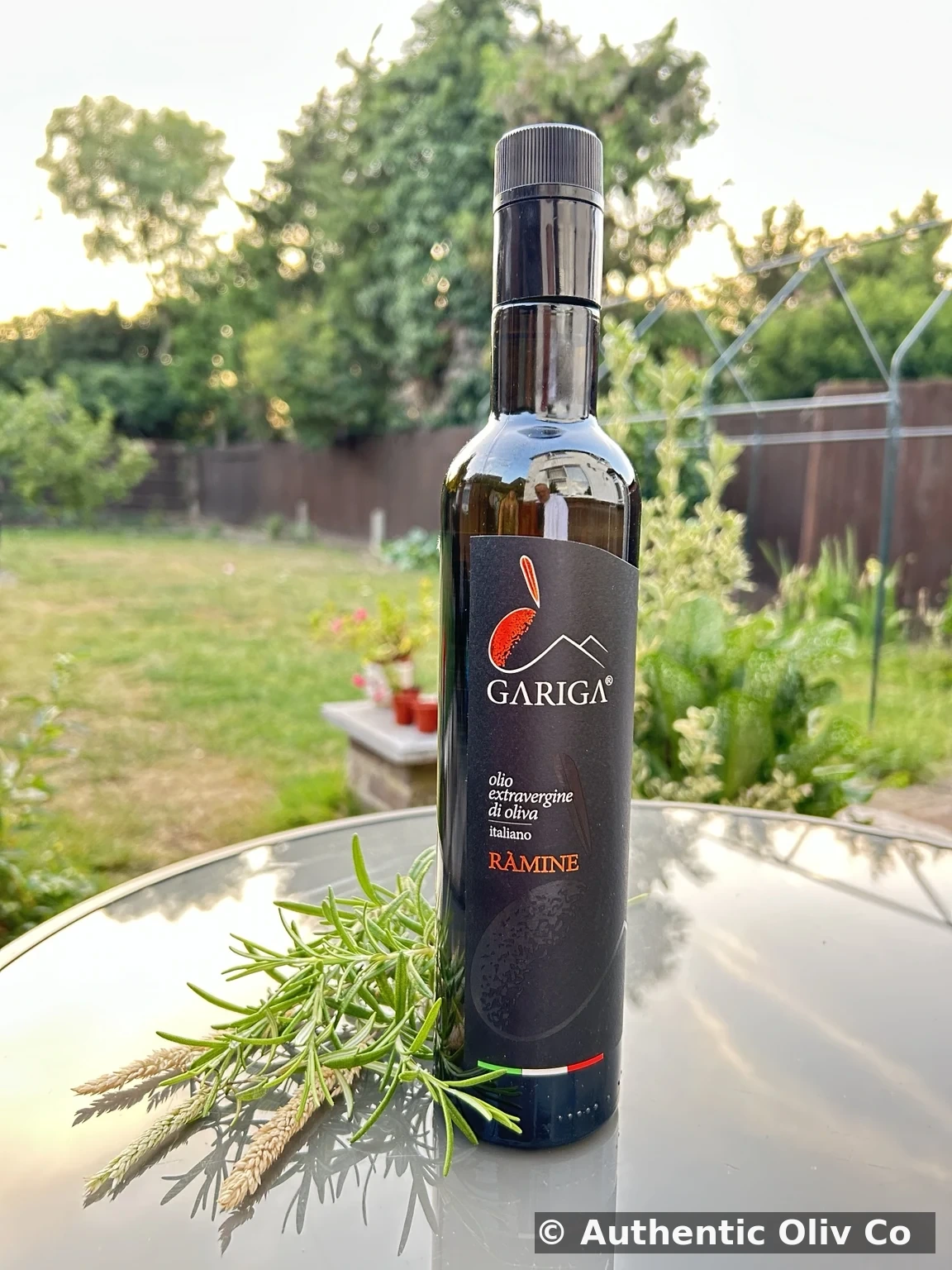
Ràmine can be described just as strongly as Birde, but its character is different: less “green-powerful”, more elegant, balsamic and precise.
RÀMINE — THE COPPER SIDE OF SARDINIA
Ràmine means “copper” in Sardinian.
The name is important because Gariga’s naming system is built around colour, identity and sensory character. Birde is “green”; Ràmine is “copper”. The name gives the oil a distinct place within the Gariga family before you even taste it.
Ràmine is made from a single Sardinian olive variety:
Nera di Oliena.
It is therefore a monocultivar extra virgin olive oil, not a blend.
And Nera di Oliena is not an anonymous international cultivar. It is a historic Sardinian variety whose name comes directly from Oliena, a town in central Sardinia where this olive has long been strongly established. The variety is also found elsewhere on the island, but Oliena remains its defining geographical reference.
The cultivar is known under several traditional Sardinian names, including Niedda de Uliana, Olianedda and Ulianesa, all reflecting its connection with Oliena and its dark colour at maturity. It is also a relatively late-ripening variety, traditionally reaching maturity around winter.
That already tells us something important about Ràmine:
this is not simply a “premium olive oil”. It is an interpretation of a specific Sardinian cultivar with a very strong territorial identity.
What does Nera di Oliena taste like?
The Italian National Database of Monovarietal Extra Virgin Olive Oils describes Nera di Oliena oils as having medium-to-high fruitiness, with grassy notes, tomato, fresh almond and artichoke, together with medium bitterness and pungency.
That general cultivar profile is very close to the way Ràmine itself has been described.
A detailed tasting of Su Molinu Gariga Ràmine describes it as:
- medium fruity,
- balsamic,
- strongly reminiscent of tomato leaf,
- with artichoke and apple,
- clean and vegetal on the palate,
- a pleasant, well-defined bitterness,
- followed by a balanced peppery finish.
That is a different personality from Birde.
Birde/Bosana is more forceful, rustic, herbaceous and structured.
Ràmine/Nera di Oliena is cleaner, more aromatic, more elegant and more balsamic.
Why does Gariga make Ràmine as a monocultivar?
Because blending Nera di Oliena with other cultivars would soften or alter the very characteristics that make the variety interesting.
A monocultivar allows the customer to taste:
Nera di Oliena as Nera di Oliena.
The tomato leaf, herbs, artichoke, almond, bitterness and final pepperiness are not random tasting notes added for marketing. They are characteristics repeatedly associated with the cultivar in monovarietal databases and with oils produced from Nera di Oliena by different Sardinian producers.
That is why Ràmine belongs in the same conceptual world as single-variety wine.
You are not just buying “olive oil from Sardinia”.
You are tasting one Sardinian olive variety and one producer’s interpretation of it.
Why does Ràmine suit delicate dishes?
This is where Ràmine becomes especially interesting.
Its flavour is distinctive, but it is not simply aggressive.
The cultivar combines fruitiness and aromatic complexity with a relatively harmonious structure. Another Sardinian producer describes Nera di Oliena as enveloping and fruity, with tomato and basil-like balsamic notes, while remaining soft, harmonious and elegant.
That makes Ràmine particularly useful where you want the olive oil to be noticeable without overwhelming the main ingredient.
It works especially well with:
- fish carpaccio,
- raw or lightly cooked seafood,
- grilled or steamed fish,
- vegetable soups and veloutés,
- fresh cheeses,
- tomatoes,
- delicate vegetables,
- white meats,
- simple pasta dishes,
- bread and focaccia where the oil itself can be tasted clearly.
Why?
Because its tomato-leaf and herbaceous character naturally complements vegetables and Mediterranean ingredients.
Its balsamic freshness works well with raw or lightly cooked fish.
Its bitterness and final pepperiness give enough structure to stop the oil disappearing, but Ràmine does not need a heavy dish to make sense.
That is the key distinction.
With a very powerful meat dish, mature cheese or intensely roasted flavours, the stronger character of Birde may be more appropriate.
With fish, fresh cheese or a delicate vegetable dish, Ràmine can be more precise.
The olive behind the name
Nera di Oliena itself is fascinating.
The olives are relatively large, spherical and darken uniformly to black at full maturity. The cultivar is traditionally considered suitable primarily for oil, although its relatively large fruit has also allowed small-scale use as a table olive.
Published cultivar research shows that the chemical composition of Nera di Oliena varies between samples, growing conditions and harvests. Those cultivar-level findings must not be presented as laboratory values for Gariga Ràmine or for every bottle.
That distinction matters for Authentic Oliv Co:
cultivar characteristics are one thing; batch-specific laboratory analysis is another.
Ràmine and the identity of Oliena
The connection with Oliena goes deeper than just the name.
Oliena has a long olive-growing tradition. Municipal material identifies Nera di Oliena as the most widespread olive cultivar in the area and confirms that its name comes directly from the territory.
So when Gariga chooses Nera di Oliena for Ràmine, it is not simply choosing an interesting olive.
It is choosing a cultivar carrying a very specific Sardinian geographical and cultural identity.
Ràmine versus Birde
This is probably the easiest way for a customer to understand the difference:
Birde — Bosana
Green, structured, herbaceous, decisive.
Artichoke, thistle, grass, almond.
Better suited to stronger Mediterranean dishes.
Ràmine — Nera di Oliena
Elegant, aromatic, balsamic, cleaner.
Tomato leaf, artichoke, apple, herbs and fresh almond.
Particularly suited to fish, fresh cheese, vegetables and more delicate dishes.
Neither is “better”.
They are different cultivars with different personalities.
And that is precisely why they should not be expected to taste the same or cost the same.
RÀMINE — COPPER, ELEGANT, SARDINIAN
Ràmine is not simply another Gariga extra virgin olive oil.
It is Gariga’s interpretation of Nera di Oliena — a cultivar named after one of Sardinia’s historic olive-growing territories.
Its character is aromatic rather than heavy, vegetal rather than neutral, and structured without becoming overpowering.
That is what makes it particularly useful in dishes where olive oil should be clearly present, but where the food itself still needs room to speak.
Sources
- Gariga — Ràmine, monocultivar Nera di Oliena
- Municipality of Oliena — local olive-growing documentation
- Accademia Nazionale dell’Olivo e dell’Olio — cultivar research
Ràmine. Copper. Nera di Oliena. Elegant Sardinia in a bottle.