Sardinia has many olive varieties, but few of them are as strongly connected with the island as Bosana. It is a variety that produces a decisive, green, intensely fruity and distinctly peppery olive oil. It is not a neutral oil, nor one created to disappear into a dish. A good Bosana has its own character and can change the flavour of an entire dish.
This is exactly why, in Sandalia’s range, Bosana appears as a monocultivar — an olive oil produced from a single olive variety, allowing its natural profile to remain unsoftened by other cultivars.
What is Bosana?
Bosana is one of Sardinia’s most characteristic olive varieties and is particularly strongly associated with the northern part of the island. Sardinian producers describe it as the most widespread variety in Sardinia, with millions of trees growing mainly in the north of the island. It is also known by the name Palma di Alghero.
However, the importance of Bosana goes far beyond the scale of its cultivation. Over the years, it has become one of the varieties that best represents the stronger style of Sardinian olive oil: green, herbaceous, bitter and peppery.
The Italian National Database of Monovarietal Extra Virgin Olive Oils has collected data from as many as 260 Bosana samples from Sardinia over a period of 21 years. This is an exceptionally broad database, allowing Bosana to be viewed not as a single product, but as a well-documented variety with its own consistent profile.
What does Sandalia Bosana taste like?
Sandalia describes its Bosana as an olive oil with intense fruitiness, with aromas of:
tomato, artichoke, freshly cut grass and aromatic herbs.
On the palate, bitterness and pungency are strong, similar in intensity and persistent. The olive oil is also fairly fluid and slightly astringent. After swallowing, it leaves a green, herbaceous character and a distinctive sensation of cleanliness in the mouth.
This is very important because bitterness and the peppery sensation in a good extra virgin olive oil are not defects. In the case of Bosana, they are part of the variety’s natural profile.
An independent Italian database of monovarietal olive oils describes Bosana in a similar way: medium to strongly fruity, with notes of grass, artichoke, fresh almonds and tomato, together with pronounced bitterness and pungency.
Where does this characteristic pepperiness come from?
One of Bosana’s most interesting characteristics is its natural tendency towards a high content of phenolic compounds.
The long-term Italian database reports an average phenolic content for Bosana of approximately 415 mg/kg for analyses carried out using the newer method since 2022, with an observed range of approximately 254–633 mg/kg. Historical data measured using a different method also showed high results.
A study published in Food Chemistry found that, during the analysed harvesting period, Bosana was among the varieties maintaining a very high content of phenolic compounds — in the tested samples it amounted to approximately 592–788 mg/kg. The researchers noted that Bosana maintained high phenolic levels throughout the studied ripening period.
Another study comparing several native Sardinian varieties found that Bosana had the highest level of total phenols and the highest antioxidant activity of the hydrophilic fraction among the olive oils tested.
However, one point must be emphasised: these are data relating to the Bosana variety and scientific samples that were studied, not a declaration of the polyphenol content of the current batch of Sandalia Bosana. Such a result can only be attributed to a specific bottle after laboratory analysis of that particular batch.
A high proportion of oleic acid
Bosana also has a characteristic fatty-acid profile.
Data covering 260 samples show an average oleic acid content of approximately 71.7%, with an average linoleic acid content of approximately 10.4%.
This is another element showing why every extra virgin olive oil should not be treated as the same product. The olive variety, place of cultivation, harvest time and processing method all have a real influence on the final composition and flavour of the oil.
How does Sandalia produce its Bosana?
This is where the part that particularly distinguishes Sandalia begins.
The company was founded in San Sperate in southern Sardinia, starting from the family’s olive groves. Sandalia states that the farm developed to approximately three hectares and around one thousand olive trees. The producer combines the tradition of family cultivation with a more technical approach to olive oil production and storage.
The process is very rigorous.
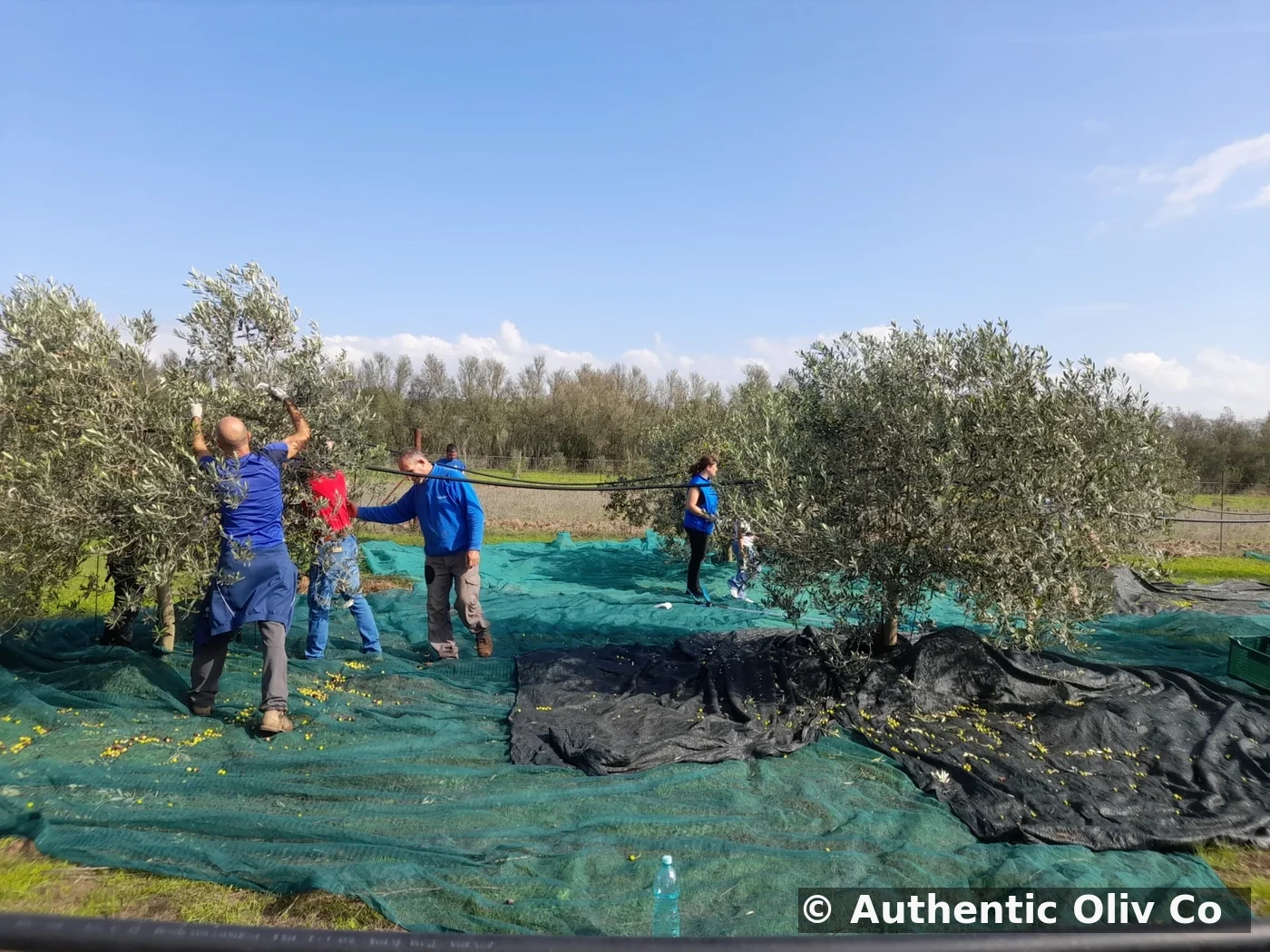
The olives are harvested by hand, then placed in ventilated crates that help reduce the risk of fermentation beginning. They are kept in a cool place and processed within a maximum of 12 hours from harvesting.
Sandalia begins harvesting at the start of veraison, when the olive begins to change colour from green to darker shades. After harvesting, the fruit is cleaned, leaves are removed and the olives are washed.
Extraction below 25°C
Sandalia carries out extraction at a temperature below 25°C.
The producer also emphasises that it does not use an identical process for every olive variety. Individual cultivars receive their own processing parameters, selected in such a way as to bring out their individual aromas and organoleptic characteristics as effectively as possible.
For a monocultivar such as Bosana, this is particularly important. The aim is not to create a uniform, neutral oil, but to preserve the character of the specific fruit.
Filtration and protection from oxygen
After extraction, Sandalia olive oil is filtered directly during the production process. Removing residual water and microscopic pieces of fruit helps to reduce degradation reactions during storage.
The oil is then transferred into AISI 304 stainless-steel tanks, where the space above the oil is protected with nitrogen. This inert gas reduces contact with oxygen and therefore limits oxidation.
Sandalia uses another interesting solution: it bottles the olive oil according to individual orders, rather than storing ready-filled bottles for long periods, where they would be exposed to greater contact with oxygen and light.
This approach fits very well with the philosophy of fresh, high-quality extra virgin olive oil.
Bosana and the moment of harvest
Even within a single variety, olive oil is not identical every year.
Studies of Bosana carried out in different parts of Sardinia have shown that both the place of production and the degree of ripeness of the fruit influence its chemical composition. Interestingly, Bosana’s sensory profile proved relatively stable in relation to changes in fruit maturity, although pigments and some phenolic components changed.
This demonstrates how important the producer’s decision regarding the moment of harvest is. Premium olive oil therefore begins not in the bottle, but much earlier — on the tree.
What should Bosana be paired with?
This is an olive oil intended above all for dishes capable of standing up to its character.
Sandalia particularly recommends Bosana with:
red meat, legume soups, bruschetta, salads and served raw as a dip.
We would go even further.
A few drops of good Bosana over a hot steak create a completely different experience from using a delicate olive oil. The same applies to a thick bean or lentil soup — its bitterness and pepperiness cut through the heavier flavours of the dish.
It also works beautifully with:
roasted vegetables, grilled aubergine, ripe tomatoes, pecorino, burrata, grilled bread or potatoes.
And the simplest test?
A good piece of bread, a little Bosana and nothing else.
Then there are no ingredients behind which the olive oil can hide.
Bosana does not try to please everyone
And that is precisely what makes it interesting.
Someone accustomed to very mild supermarket olive oil may be surprised the first time they taste Bosana. First come the green aromas. Then the bitterness. Finally, a peppery, sometimes almost throat-catching sensation appears.
But this character is exactly why Bosana has so many enthusiasts.
It is an olive oil for people who want to taste the olive oil, rather than simply use it as a fat.
Sardinia in its most decisive form
Sandalia Bosana combines two things.
The first is an extraordinary olive variety whose character has been well documented through years of research: high fruitiness, notes of grass, tomato and artichoke, decisive bitterness and pungency, and a natural tendency towards a high content of phenolic compounds.
The second is Sandalia’s production method: rapid processing of the fruit after harvesting, temperatures below 25°C, filtration, storage under nitrogen and bottling to order.
As a result, Bosana is not simply another bottle of “Italian extra virgin olive oil”.
It is a monocultivar with a very specific origin, character and history.
And perhaps this is exactly the kind of olive oil with which to begin discovering the real Sardinia.