“How does the flavour get into the olive oil?” It is a question customers often ask us at Authentic Oliv Co. Does the producer cook herbs in the oil? Is lemon juice added? And what does “freeze-dried” actually mean?
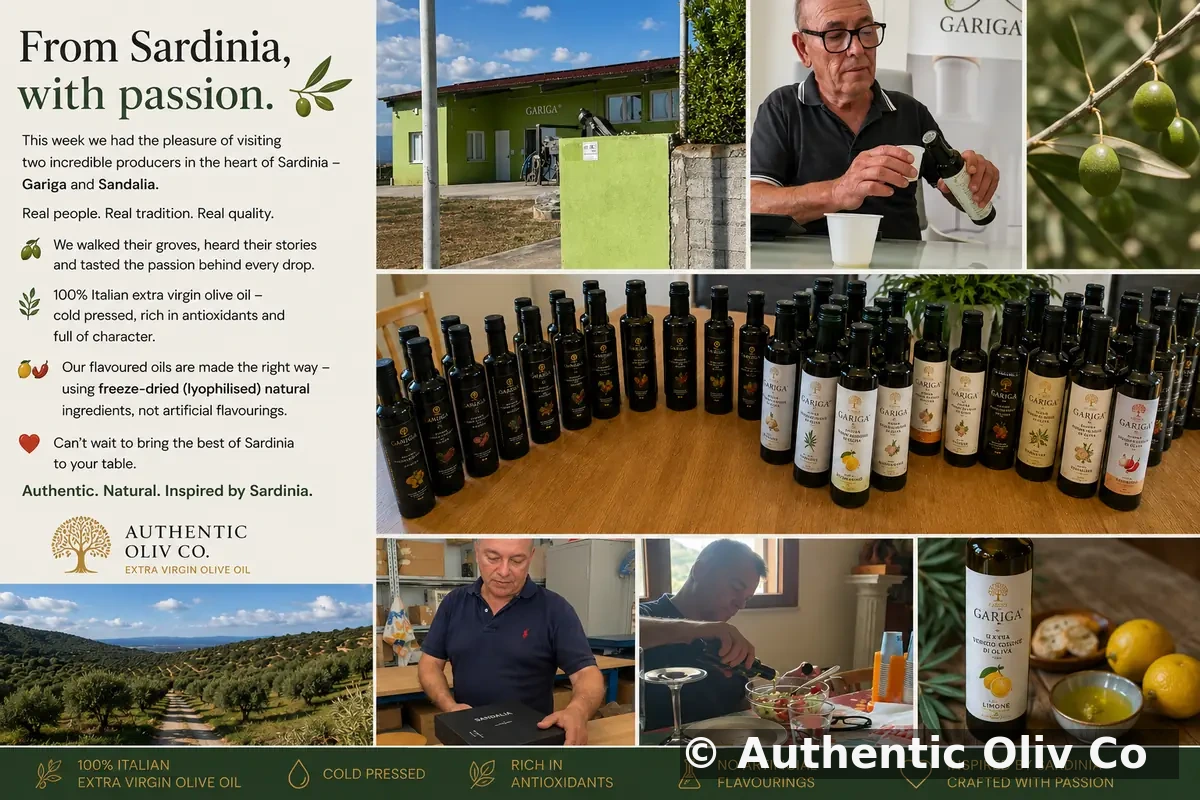
During our visit to Sandalia in Sardinia, the producer told us about cold infusion. Here, we explain how this method works when paired with freeze-dried ingredients. Individual recipes can differ; this is an explanation of the process, rather than a specification for every bottle in our collection.
It starts with the olive oil
The base matters. Extra virgin olive oil already has its own flavour, which may be grassy, fruity, bitter or peppery. A well-balanced flavoured oil brings that character together with an additional ingredient, rather than letting one overwhelm the other.
The producer selects the oil and the flavouring ingredients, then prepares them for the chosen recipe. Depending on the product, these might include herbs, spices or citrus peel.
What are freeze-dried ingredients?
Freeze-dried basil is basil that has undergone a particular drying process. It is not simply another name for an artificial flavouring.
First, the ingredient is frozen. Under reduced pressure, the frozen water passes directly from ice into vapour, a process called sublimation. Further drying removes remaining moisture. The result is a light, dry ingredient that can retain much of its original aroma and character. How well these are retained depends on the ingredient and processing conditions.
The producer may carry out this preparation or use ingredients supplied already freeze-dried. Freeze-drying prepares the ingredient; infusion transfers flavour into the oil. They are separate stages.
What happens during cold infusion?
Prepared ingredients are brought into contact with finished olive oil without deliberately heating the mixture. Over time, oil-soluble flavour and aroma compounds move into the oil.
The producer controls the proportions and infusion conditions to achieve the intended flavour. “Cold” does not necessarily mean refrigerated: the temperature and duration depend on the process and recipe.
This is also different from cold extraction, which describes making the olive oil from olives. Cold infusion describes flavouring oil that has already been made.
From infusion to the finished bottle
The producer assesses the flavour as it develops. When the intended balance is reached, solid ingredients may be removed and the oil filtered, depending on the recipe. That is why an infused oil can taste of an ingredient even when there are no visible pieces in the bottle.
Before release, a commercial producer needs appropriate quality and food-safety controls, including checks relevant to the product’s stability and shelf life. Freeze-drying alone does not replace those controls.
The finished oil is then filled into suitable packaging, sealed and labelled, with storage instructions and batch information.
How to enjoy flavoured olive oil
Try lemon with fish or roasted vegetables, basil with tomatoes and mozzarella, rosemary with potatoes, or chilli with pizza and pasta. Start with a small drizzle and taste before adding more.
Adding it at the end of cooking is a useful way to enjoy its aroma. Follow the bottle’s storage instructions and keep it away from unnecessary heat and light.
For us, understanding a product is part of enjoying it. Knowing what the ingredients are, how the flavour develops and which dishes suit it makes choosing your next bottle much easier.